Officials say the project could become a platform for wider industrial, investment and business exchanges with African countries.
Rwanda’s ambassador to South Korea has visited Saemangeum, one of the country’s largest development projects, as Seoul looks to deepen economic and industrial cooperation with African nations.
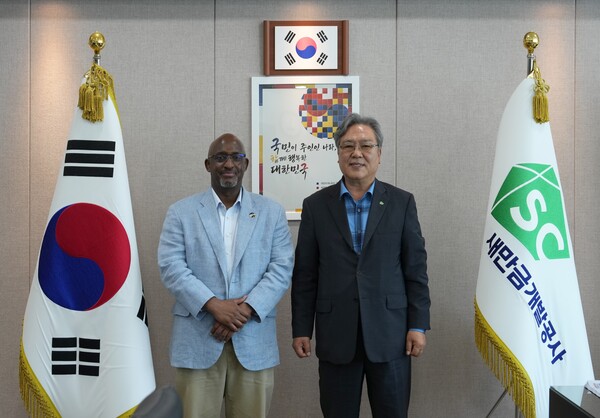
The Saemangeum Development Corporation said on 11 June that Nkubito Manzi Bakuramutsa, Rwanda’s Ambassador to the Republic of Korea, had been briefed on the project and inspected key areas of the site.
The visit was arranged as part of follow-up exchanges under a memorandum of understanding signed last year between the corporation and the Korea-Africa Foundation.
Under that agreement, the two sides agreed to work together to support market entry by companies from Saemangeum and African countries, create conditions for the growth of key industries, provide human and material support, and build networks between relevant organizations and businesses.
According to the corporation, Ambassador Bakuramutsa and his delegation showed interest in Saemangeum’s development plans, investment environment and industrial infrastructure.
The two sides also exchanged views on possible areas of cooperation with African countries and ways to expand business-to-business exchanges in the future.
Saemangeum, built on a vast reclaimed area on South Korea’s west coast, is being developed as a large-scale industrial, logistics, tourism and investment hub. South Korean officials have increasingly sought to position the site not only as a domestic regional development project, but also as a platform for international economic cooperation.
The ambassador’s visit comes as South Korea is attempting to broaden its engagement with Africa beyond traditional development assistance. Since the Korea-Africa Summit in 2024, Seoul has placed greater emphasis on trade, investment, infrastructure, critical minerals, digital transformation and industrial partnerships with African countries.
Rwanda and other African nations have seen growing demand for economic development and industrial expansion in recent years. That has raised expectations that Saemangeum’s industrial and investment model could be linked to new forms of cooperation with African partners, particularly in areas such as infrastructure development, manufacturing, technology and business exchange.
Analysts say the visit reflects a wider shift in South Korea’s Africa policy, as Seoul seeks to treat the continent as a strategic economic partner rather than only as a recipient of development cooperation. For Saemangeum, closer engagement with African countries could also help strengthen its bid to attract foreign investment and build international industrial networks.
But observers note that symbolic exchanges will need to be followed by concrete projects if the partnership is to produce results. That would require company-level matchmaking, investment plans, financing arrangements and cooperation models tailored to the needs of individual African markets.
Ambassador Bakuramutsa said he was deeply impressed by what he described as the overwhelming scale and pace of development at Saemangeum, calling it the world’s largest reclaimed land project and a site emerging as a hub for advanced industries.
He added that he hoped exchanges and cooperation between Saemangeum and African countries would expand in a wide range of areas.
The visit highlights how South Korea’s engagement with Africa is increasingly moving from summit diplomacy and government-level statements to regional, industrial and private-sector cooperation on the ground.



 By MANZI